My Photography

Showing posts with label history. Show all posts

Wednesday, April 29, 2015

Women on the 20s!

You may or may not have heard of this initiative going on in the US right now. Each bill of our paper money has a face on it, of either a president (George Washington, Abraham Lincoln...) or someone important in the nation's history (Benjamin Franklin). (See here for all the bills—including some much bigger ones than you may think exist!)


On the 20 dollar bill we see the face of Andrew Jackson, a president who did a lot for the country—some of it good, and some of it... not so much. One of his biggest, and certainly his most terrible legacy is the "Trail of Tears", formally known as the Indian Removal Act of 1830. 
"...the Cherokee nation was forced to give up its lands east of the Mississippi River and to migrate to an area in present-day Oklahoma. The Cherokee people called this journey the "Trail of Tears," because of its devastating effects. The migrants faced hunger, disease, and exhaustion on the forced march. Over 4,000 out of 15,000 of the Cherokees died."                             source
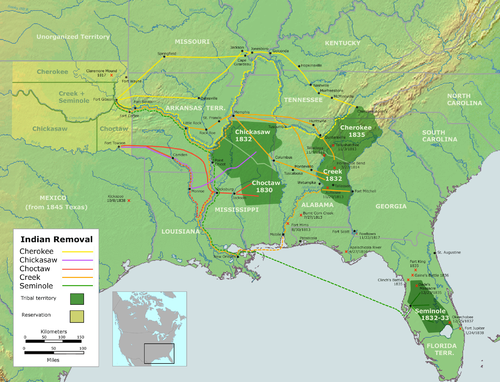
Just take a look at this map to get an idea of the scope of this relocation. For anyone familiar with the geography of the US, think about how radically different those deep south climates are from Oklahoma.

source

So do we really want to celebrate this man on one of the most commonly used US bills? Here's another reason it doesn't make the most sense that he's there:
Some argue that because Jackson was a fierce opponent of the central banking system and favored gold and silver coin or "hard money" over paper currency, he is an ironic choice for immortalization on our money.                                                                             source

One thing to remember is that the people who appear on US currency can change at any time—the President, the Secretary of the Treasury, or Congress just has to order it to be done. Another interesting fact: the faces on our bills haven't changed since 1929.

So now that we've established that Andrew Jackson's face is not the most logical, and that it's rather time for a change, who should we put on the $20 bill? Before we can answer that, these kids have an important question:


The people at womenon20s.org are trying to garner public support for the change from Andrew Jackson to a celebrated American woman on the $20 bill. This is far from being an aggressive feminist movement, it's simply a way to give some needed attention to the important women of our nation. We have lots of inspiring ones to choose from!

In March I was one of the 256,000 people who voted for my top three of the fifteen most influential American women. Now, since the beginning of April, four finalists have been identified. From the womenon20s website:


Because of strong public sentiment that people should have the choice 
of a Native American to replace Andrew Jackson, Cherokee Nation 
Chief Wilma Mankiller appears on the Final ballot.
from: www.womenon20s.org/the_process

Go here to get to that page and read these amazing women's more complete biographies. I certainly learned quite a lot!

I have two email addresses, so I'm voting twice, but I won't influence you one way or another so I won't tell you who I'm voting for, however I will tell you to go vote! Even if you aren't American! Go take a look at the womenon20s website, learn a bit about the history of that country, and really, why not vote? The more people vote, the more likely it is that one of these women will appear on the 20 dollar bill in 2020, right in time for the 100th anniversary of women's suffrage in America!


Sunday, April 12, 2015

A day in Tangier

While we slept and spent lots of time in Assilah, we took advantage of the fact that it's located only 40 minutes from Tangier to explore that city a bit! I had never been there and Othman was very small the last time he was there. Not having a guide (his uncle who lives in Tangier was out of town) we ended up getting lost more than a few times, but were able to see quite a lot of the city as a result! Our first destination was in the old medina, and finding it was no easy task but we made it eventually. 

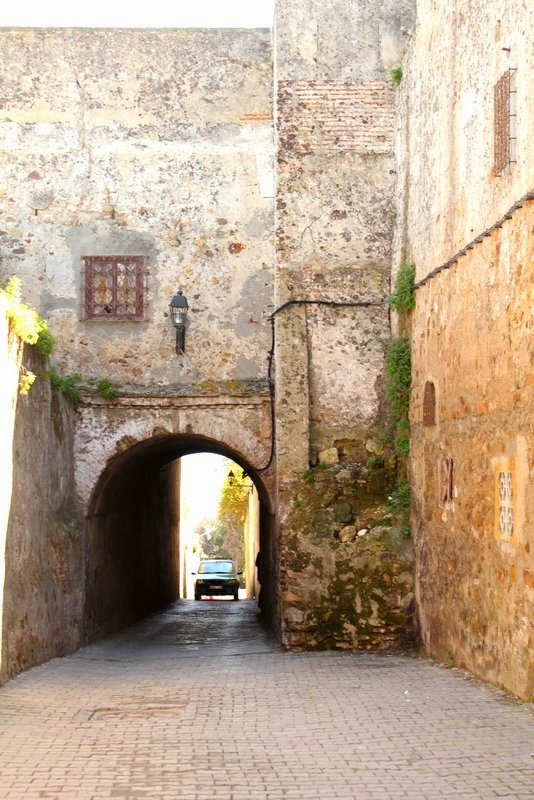
The walk in:


Then we got sidetracked...


and got our first view of Spain! It's that small dark line above the clouds.


Not long after that we found a museum which used to be an old palace. Wandering though it was impressive, as I imagined all that must have taken place within itsits walls. Othman and I agreed there was something distinctly Game-of-Thrones-esque about the place!


While the museum wasn't particularly well set up, and informative only in the driest of ways, the experience of walking through the palace and stumbling upon things like these was incredible:


Afterwards we followed some terrible signage looking for the tomb of Ibn Battuta (the Marco Polo of the Arab world, who happened to be from Tangier) but were disappointed to see it was just a little building the size of a shack that was dedicated to him. It was also locked. Then we realized we were extremely lost in the winding pedestrian streets of the old medina, but were saved by a guide in the form of a ten year old girl. Phew! I posed in front of this pretty wall on the way down:


Leaving the city we headed up to Cap Spartel which is in a large national park just minutes from Tangier. The cape features a historical lighthouse that we admired. Unfortunately the clouds were blocking most of the view we should have had of Spain and the Atlantic.


After grabbing a quick orange juice at the cafe overlooking the ocean we wandered around the park some more, spotting some wildlife:


And even the lighthouse again!


All tired out, we then headed back to Assilah for a well deserved rest.

Monday, March 23, 2015

Art, photography and friends!

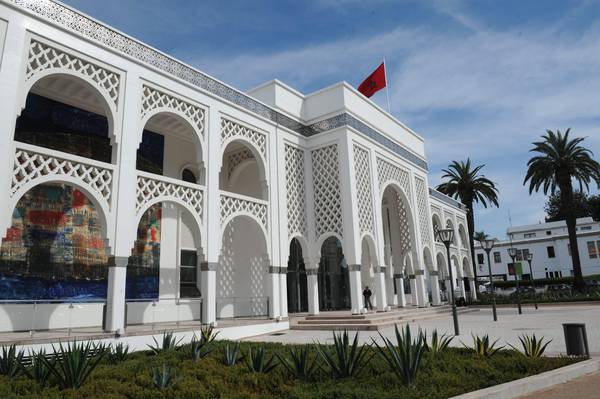
A few weeks ago Othman and I had plans to join up with some friends of ours, another mixed-nationality couple, and have a picnic in a forest close to Casablanca. When I got sick the day beforeand thus had to cancel I became quite frustrated, as I was really looking forward to hanging out with them. Once I got better we started planning again, but due to the daily rain we've been getting here in Casa we had to come up with a different outing. I asked how they'd feel about heading to the new Mohammed VI Museum of Modern and Contemporary Art in Rabat that was inaugurated a few months ago, and they agreed on making a day of it! So yesterday the four of us piled into our car and headed to Morocco's capital city.


We met Gioia and Driss at the first Pages event we went to, at which she told the story of how she ended up here, and then he played music with his fantastic band. (They're mentioned in my first post about Pages here!) 

A very cool picture of Gioia from the next Pages event- when I spoke!
Photo cred

Since then we've kept in touch and seen each other a couple times, and really enjoy spending time together. With our busy lives it's difficult to make time to help friendships grow, but it really is so important, and is something I've been pushing Othman and me to do recently. Gone are those university days when you become friends with people easily and almost by default, spending most of your time with them. As busy, working adults we have to make time and reasons to get together, and while it's a bit of a pain it's so rewarding!

Photo cred

Both Gioia and Driss and Othman and I had been talking separately of going to the museum for a while, as its opening caused quite a sensation and it has gotten lots of media attention. Museums are few and far between in Morocco and it's great to see more being built! It made a lot of sense, however, to go as a foursome because of our different approaches to art. Driss and Othman are Moroccan and didn't grow up in "museum cultures" as Gioia, an Italian, and I did. As a result she and I enjoyed discussing what we saw together as the boys had fun giggling at the pieces they didn't like as they lagged behind. The four of us had some very interesting conversations within the galleries talking about different ways of considering art and delving into why they had a harder time with some of it than we did. The talk ended up being educational for us all as we learned the others' perspectives!

Photo cred

While the new museum is supposed to be focused on modern art, its new exhibition (which was created in collaboration with the Louvre and will travel there afterwards) actually displays medieval Moroccan art from the 8th to 13th centuries. This is an interesting choice and is a testament to how museums are needed here—there really isn't another establishment able to house such an exhibit. I thought the juxtaposition was apt, however. Starting with the traditional and classic works of architectural, literary and functional art downstairs and then moving to the 20th century upstairs for the second half of our visit gave us perspective on how the second grew from the first. Tradition is of paramount importance in Moroccan society and while modern and contemporary artists are almost by definition moving away from tradition, in many ways its motifs and themes creep into their works. It was also good because the boys were more interested in that first part while Gioia and I appreciated the contemporary exhibit much more, which meant that there was a little something for everyone. We all left impressed with the museum's quality, despite a few missing labels and many explanations in the first exhibit being only in Arabic—but hey we're still in Morocco after all. I thought its size and scope were perfect: meaty enough not to be disappointing but very managable at the same time. And the entrance price means it's accessible to many!

One of the modern pieces we all loved.

Having arrived in Rabat quite a bit later than we meant to, for various reasons, we stayed until the museum closed and may well have been the last visitors to leave. We then headed to the coast not far away to enjoy the sunset and have some dinner. I whipped out my camera and went to town taking pictures. I’m not often in Rabat, and enjoyed seeing different views from what’s typical in Casablanca. We admired the sea and the architecture and found some cute snails to photograph too!


Not only am I not often in Rabat, but I’m also not often ready with my camera during twilight and at night, so I made the most of the opportunity to play with the settings and experiment a bit. I took advantage of the light of the setting sun behind the clouds and later on got some fabulous night shots.


As we headed down towards a bar-restaurant right on the beach I turned around and snapped this funny photo.


Inside we ordered a bunch of appetizers to share, as we talked and laughed all together. We took a few nice pictures as we waited, then tucked into some delicious seafood.


After eating we walked back up to the car and they laughed as I stopped every 20 meters or so to take pictures, but in the end I don’t think anyone minded too much, and I was happy with the results!


The drive down wasn’t short in time but felt so, as Driss and Othman laughed and joked in the front Gioia and I shared we’re-married-to-Moroccans stories in the back. Othman and I dropped them off at home with promises to get together for dinner soon, especially as we realized we all have the same tastes in dining out, down to a favorite restaurant in common! Thanks for a lovely day, Gioia and Driss, and see you both soon!


Monday, February 23, 2015

Silent Hitchcock


Last night Othman and I went to an incredibly interesting event—the screening of Alfred Hitchcock's very first film, called The Pleasure Garden. It was held at the 7eme Art cinema in Rabat and was part of a British Council Morocco’s third annual “British Film Week”. British Council does lots more than just hire people like me to teach English, but I don't often get to experience those different aspects of the organization. Last night was an absolutely wonderful exception!


The movie was filmed in 1926 (!!) when Hitchcock was just 27 years old, and is a silent film about two dancing chorus girls and their eventful love lives. Watching a silent film would generally not be the most interesting of activities, but this one was accompanied during its entirety by British composer and musician Stephan Horne, on no less than four separate instruments.


I had never actually seen a silent film before, and it was really more fun than I had anticipated. Sitting in the darkened theater in downtown Rabat, just a few rows away from the musician, I felt transported back in time. In older movies we've all seen theaters full of moviegoers in the early 20th century laughing along with a silent film and its accompanying pianist, and last night I was a part of one of those audiences! Although the movie was most decidedly a drama, and not a comedy, the fact that it was silent meant that there was a fair amount of slapstick humor involved. It was also interesting to note how every gesture and expression had to be exaggerated, similar to stage acting, due to the nature of the silent film. Though the actors' performances were very different from what we're used to in modern movies, they left no doubt of their talent!


One thing that I had never given any thought to before was a very interesting coloring technique used in the movie. Yes it was black and white, but the entire screen would be tinted a different color depending on the setting or the mood of the scene. Outside, nighttime shots were tinted blue, inside shots an unobtrusive yellow, candlelight dinners had an orangey glow. It was a fascinating and very interesting addition to the overall experience!

Another observation I made was how little dialogue is actually needed for one to understand a story. Very often throughout the movie the characters would interact and talk but the audience was simply left to surmise what they said. Amazingly, it worked incredibly well. The shots in which the screen had a static background and words were displayed were used at a minimum to move the story along, and rarely for dialogues. They slows down the story a lot because they were left up on the screen for a significant amount of time to ensure everyone had time to read and understand. At times I even felt annoyed with the words, having already guessed what was written in their content. It was all very far from what I had vaguely assumed going in—namely that every scene would be accompanied by one.


The star of the night, however, was most certainly the composer and musician, Stephan Horne. We ended up sitting just in front of some British Council colleagues of mine who also travelled from Casablanca for the showing, and we were directly behind Mr. Horne. Throughout the film I kept an eye on him, watching his seamless transitions from piano to accordion to mini-harp to flute, and often marveled at how he would play two instruments at once! (The flute-piano combination was rather mind-boggling.) At the darkest and most intense parts he even started banging on the strings on the INSIDE of the baby grand! He never faltered, and matched the mood of the movie incredibly well, and even provided sound for the inevitable-in-Hitchcock-films gunshot. Apparently he’s somewhat of a Hitchcock aficionado which made his contribution even more special. After the film ended and a bunch of British Council attendees has made a circle outside the theater to discuss it, he made an appearance and we were able to express our admiration and ask a few questions. He said he’s a full time musician and right now his main source of work/income is travelling around the world to silent film festivals and doing what he did last night! What an incredibly interesting niche market job! If anyone reading this will be in San Fransisco in April and May he said he’ll be there for a festival then.

Blurry, but look at that talent! 

This link has more information about the film week, which extends through Wednesday in Rabat and will also be travelling to Agadir and Tetouan in the coming weeks. Don’t miss it!!


Friday, August 22, 2014

The Hassan II Mosque in Casabanca

Although my family came to Morocco for a very short visit and we weren't able to take them outside of Casablanca, we did manage to have a few nice outings around the city! They loved wandering around Morocco Mall, absolutely adored Habbous, (a market built by the French during colonial times that is a cleaned up version of the traditional Moroccan souks) and ogled at the beautiful Hassan II mosque with us. I didn't get pictures of the mall or the Habbous trip (though I might steal and post some later), but here are some images from when we all went to see the mosque. 


Not Where's Waldo— Where's Alli??

We weren't able to go inside due to time and monetary constraints, but having been on the tour twice before, I acted as the unofficial tour guide. The Mosque was built in the late 80s-early 90s, and was commissioned by King Hassan II (the father of current King Mohammed VI). Officially it was for his 60th birthday (though it ended up being finished four years too late!), but it also served as an economic stimulus, since all but a very few raw materials were sourced from Morocco, and the laborers and craftsmen were Moroccan as well. Only a few marbles pillars and chandeliers came from Italy, and the head Architect was French (go figure).


The design of the mosque is unique because it ties traditional Moroccan architecture with Islamic architecture, yet does so in a very modern way.


The mosque is the largest in the world that allows non-Muslims inside, but only on the guided tours. The reasons for that are plentiful—there is daily prayer five times daily which shouldn't be interrupted, shoes must be removed going inside because the carpet on which they pray must remain clean, and the upkeep of the Mosque is expensive so while the very informative tours are priced somewhat high at 100 dirhams ($12) per person, the profits pay for the maintenance of the building.


Everyone was duly impressed walking around--the scale is simply massive, (the minaret is the tallest in the world at 210m / 689ft) and the intricacies of the architecture are only visible relatively close up. Casa can't boast a whole lot of sightseeing opportunities, but this one makes up for a lot!